Recently, Guinness World Records Official certification announced NPU in collaboration with Xi’an Tianhe Maritime Technologies Co., Ltd. (both China) set a world record for “the most autonomous underwater vehicles operating simultaneously”.
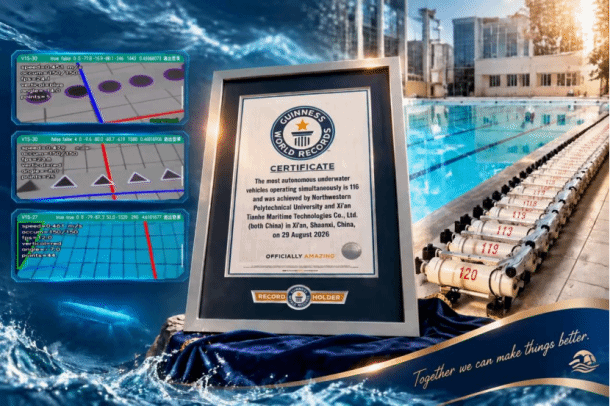
Official Guinness World Records certificate
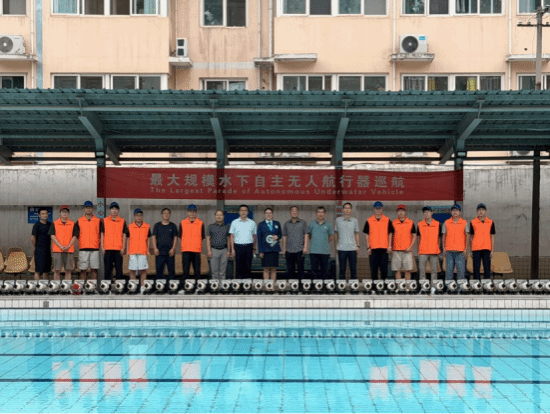
Group photo of team members with Guinness World Records official adjudicators and experts
On August 29, 2026, under under the full supervision of Guinness World Records official adjudicators and expert observation teams, the TH-618 Autonomous Underwater Vehicles were sequentially deployed into the water. The vehicles immediately entered fully autonomous underwater navigation mode, with no human intervention throughout the entire operation. Using real-time visual perception technology, each vehicle autonomously coordinated with the others, maintained the designated formation, and navigated underwater in an orderly manner. After 34 minutes of stable and continuous operation, the vehicles successfully completed formation navigation along a predetermined route of more than 500 meters.
Following rigorous verification and a comprehensive review of the entire operation by Guinness World Records, it was officially confirmed that 116 autonomous underwater vehicles successfully achieved simultaneous formation navigation. Thus, a new Guinness World Record was established!
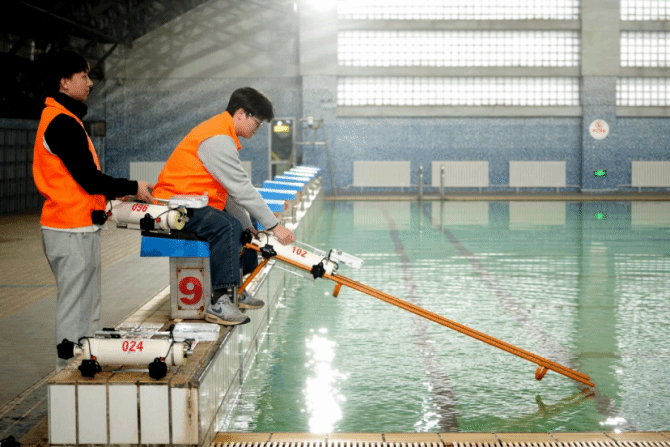
The team conducted preliminary deployment tests.
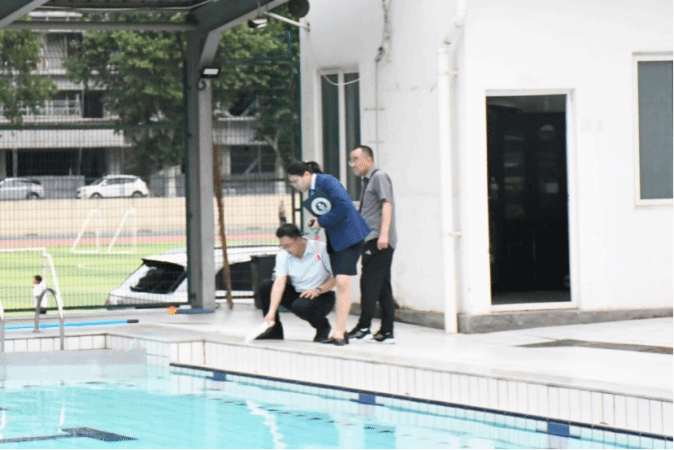
On-site verification by Guinness World Records official adjudicators
How Difficult Is Coordinated Underwater Navigation?
The underwater environment presents numerous challenges, including complex conditions, the absence of wireless communication signals, the inability to transmit commands in real time, the lack of satellite navigation systems, and the impossibility of relying on external systems to calibrate routes. Additionally, operators must contend with high water pressure, low underwater visibility, limited environmental perception capabilities, and a low tolerance for operational errors. Under such circumstances, enabling dozens or even hundreds of underwater vehicles to achieve fully autonomous, long-duration coordinated navigation while maintaining a stable formation has long been a major challenge in the field of intelligent underwater systems worldwide. This time, the successful stable navigation of a fleet comprising hundreds of vessels represents a significant breakthrough in achieving large-scale coordinated operation of underwater unmanned systems.
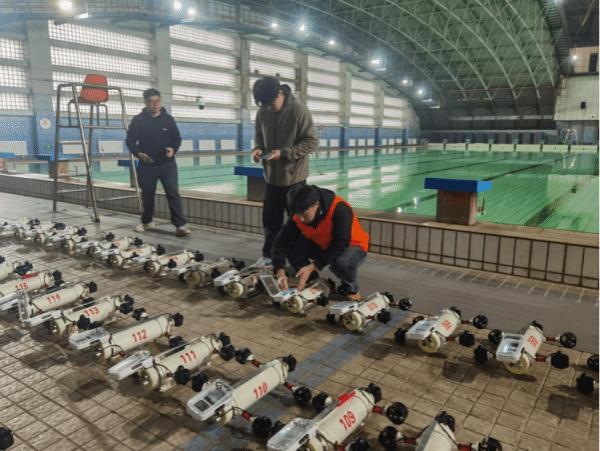
Centralized equipment commissioning
Compact and Highly Intelligent, Able to Navigate Underwater on Its Own.
The TH-618 autonomous underwater vehicle that set the world record measures 61.5 cm in length, 20 cm in width, and 28 cm in height, with a total weight of just 5.14 kg. It can be rapidly deployed by a single operator, has a maximum cruising range of 30 kilometers, and can operate continuously for more than eight hours. With a navigation accuracy of ≤5%, it also offers strong stability during underwater operation.
Compact size, however, is only the starting point. The TH-618 features a multi-degree-of-freedom thruster configuration and, supported by a smartphone-based visual sensing system, can perform a range of precise maneuvers, including vertical ascent and descent, turning in place, underwater hovering, depth and speed control, terrain following, and landmark recognition. It can also carry out autonomous missions along predefined routes. When encountering unexpected conditions such as water disturbances or minor collisions, the vehicle can rely on an embodied-intelligence-based adaptive correction mechanism to autonomously detect anomalies, recover from disruptions, and quickly return to its designated route or formation position.
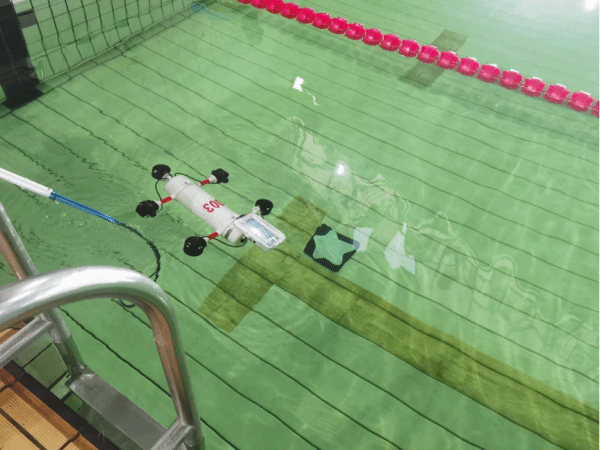
The device utilizes the hardware of general-purpose smartphones to create an integrated perception and control system. By adopting a highly integrated solution, the overall architecture is simplified, providing a new technical approach for the lightweight and widespread development of intelligent underwater equipment.
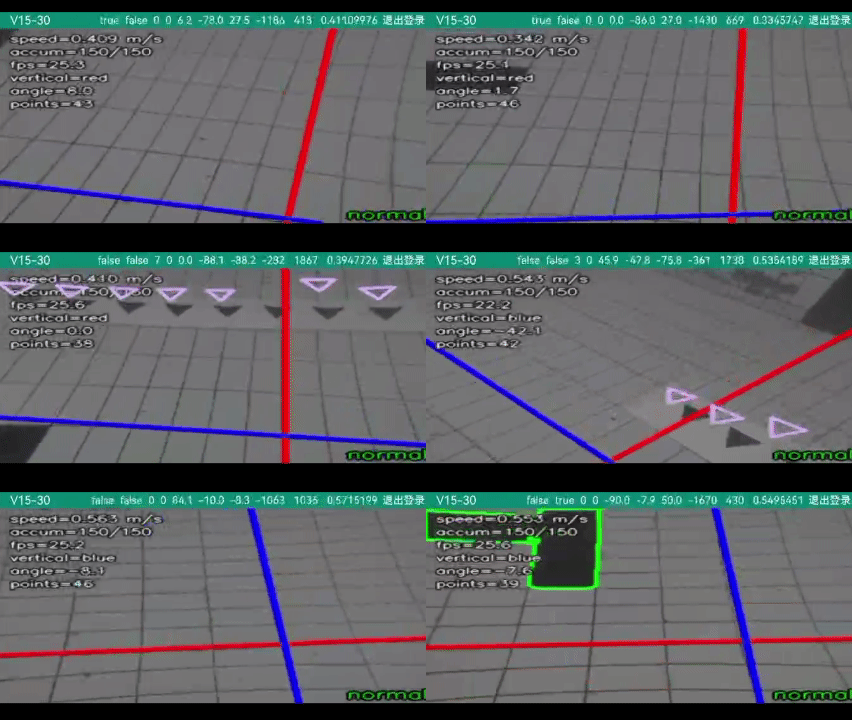
Behind this world record are more than two decades of sustained research and industrialization efforts. Since 2010, the team led by Professor Chen Jianfeng from the School of Marine Science and Technology of NPU has continuously focused on technologies such as underwater information sensing, underwater target detection, and intelligent unmanned vehicles. They have accumulated extensive research achievements in areas like acoustic communication and underwater visual perception. Xi’an Tianhe Maritime Technologies Co., Ltd., founded by NPU alumni, has long been engaged in the industrial development of autonomous underwater vehicles and has established mature capabilities in overall system design, precision manufacturing, process optimization, and quality control.
The collaboration between the university and the enterprise began with major national research projects; from fundamental research to key technological development, the two sides have continued to explore deeper integration of industry, academia, and research, accelerating the application and iterative improvement of scientific and technological achievements. This breakthrough enables the integration of the research team’s intelligent algorithms, multi-vehicle coordination technologies, and large-scale equipment manufacturing capabilities, providing a solid foundation for the practical use of these technologies.
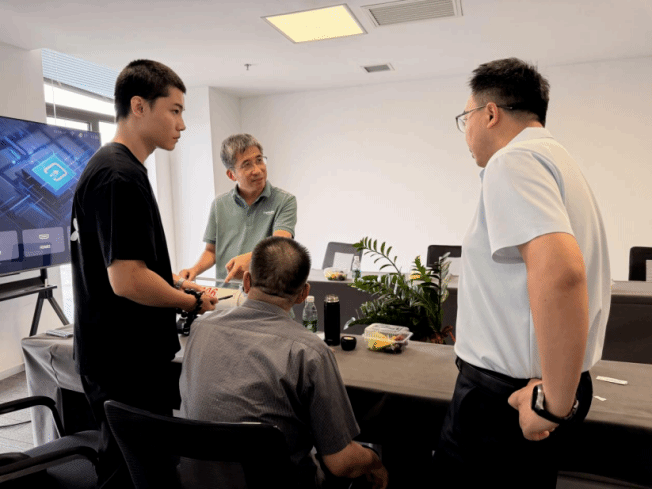
Professor Chen Jianfeng and team members conducted relevant technical discussions
Looking towards the future, Professor Chen Jianfeng’ s team will rely on a platform for clusters of miniaturized underwater vehicles to continue to tackle key technological challenges. The team will further explore the potential of marine exploration and underwater operations and develop new technological pathways for deep-sea development and utilization.
Production: Media Office of the NPU Committee of the CPC
Source: School of Marine Science and Technology
Text: Chen Jianfeng Zhang Yali
Photos: Zhang Yifan
Editors: Ren Yitong Zhong Wanming
Copy Editor: Zhao Zhen
Reviewers: Liu Chaoya Fu Yi
Translators:Meng Qingnan, Mei Leyun
